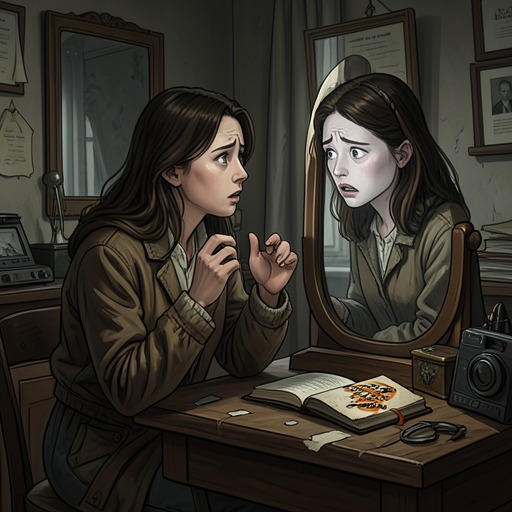
Aza’s mother
Turtles All the Way DownAza’s mother is an unnamed parent whose care is expressed in domestic routines, apologies, and an increasingly urgent effort to stay close to Aza Holmes as her mental health worsens. She cannot control Aza’s intrusive fears or grief, but she notices their consequences and keeps returning to the difficult work of asking how Aza is doing, offering reassurance, and asking for her attention in return.
Identity and Everyday Presence
Aza’s mother appears in the ordinary spaces of home: watching television with Aza, grading tests on the couch, drinking tea at the kitchen table, and moving through the household in a familiar flurry. These details give her presence a practical texture. She is not introduced through a separate account of her own history; the reader encounters her in relation to Aza, through the small acts and exchanges by which a parent shares a home with a struggling teenager.
That domestic closeness does not mean she can always tell what Aza needs. When Aza returns from a visit with Dr. Karen Singh, her mother tries to sound calm while grading tests, but Aza senses her nerves. Her question about the appointment is simple; its careful delivery suggests that she is waiting for news while trying not to make the moment more difficult. Aza answers only that it was good, more or less, leaving the mother’s worry present but unresolved.
Care, Grief, and the Father’s Phone
Aza’s father’s old phone becomes a private way for Aza to revisit her father through photographs. After an evening with Davis Pickett, Aza retrieves the phone, charges it, and sits scrolling through images of sky split by tree branches. Her mother appears behind her and gently points out that the same photographs are backed up on the computer. The remark is practical rather than confrontational: she recognizes what Aza is looking at without demanding that Aza explain why she needs the old device.
When her mother asks whether Aza had been talking to her father, Aza answers that she tells him secrets because he is good at keeping them. The exchange shows grief persisting inside a familiar family conversation. Aza’s mother does not correct the imaginative intimacy or force it into a more literal account. Instead, she has approached quietly, noticed what her daughter is doing, and left room for Aza to describe the attachment in her own terms. Her reassurance that the photographs are safe also addresses the phone’s practical importance, but it does not make the old object emotionally interchangeable with its backup.
Apology and Family Strain
Aza’s mother recognizes that she has hurt Davis’s feelings and tells Aza she has written him an apology note. She acknowledges that she took things too far, while also trying to explain what Aza needs to understand. Aza waves away the explanation and changes the subject, making the exchange a partial, unfinished repair rather than a clean reconciliation. The mother takes responsibility for her own conduct; Aza, however, is not ready to stay in the conversation.
She returns to the apology after Aza’s visit with Dr. Karen Singh, saying again that she is sorry for how she spoke to Davis and that Aza has a right to be upset. This repetition matters: the apology is not confined to a single moment, and the mother does not treat Aza’s first dismissal as proof that the hurt has disappeared. At the same time, the scenes offer no indication that her apology immediately resolves the tension. Her care includes an attempt to repair a relationship, but she cannot dictate when Aza is ready to receive that repair.
Crisis and the Limits of Reassurance
When Aza is hurt in the car accident, her mother is beside her in the hospital hallway, crying so hard that her makeup runs. After learning that Aza is awake, she collapses into Daisy Ramirez. Aza tries to reassure her and mentions that Aza’s father’s old phone is broken; her mother answers that the information on it is backed up, then breaks down again while explaining that she had been told Aza was injured without being told whether she was alive. The moment briefly places a concrete loss beside the much greater fear of losing her daughter. Her concern is physical and immediate, visible in her tears and in the way she leans on another person.
Later, when Aza keeps the reward money, her mother does not frame their disagreement as a simple argument about money. She tells Aza that her life is hers, but warns that her mental health over the preceding months has changed. Aza answers that she was already ill; her mother distinguishes the recent severity from that longer history and says she needs Aza to be well because she cannot bear to lose her. The exchange makes the mother’s fear explicit without establishing that money itself caused Aza’s deterioration. She is trying to name a change she has witnessed, even as Aza insists that the underlying illness predates it.
Concern, Trust, and the Ending
Aza’s mother eventually tells her directly that she is worried Aza is losing her connection to reality. Aza denies it and says she is tired, but her mother does not let the answer end the matter: she insists that they stay up and talk that night. Her response is an attempt to create attention and time when Aza’s brief reassurance does not persuade her. The scene shows both the mother’s vigilance and its limits; she can ask Aza to remain present with her, but the conversation is needed precisely because a quick exchange cannot settle the concern.
Their conversation about Russell Pickett’s disappearance brings that concern into contact with a consequential decision. Aza says she will tell Davis Pickett but not the police, explaining that an official discovery of Russell Pickett’s death could mean that the house would belong to a tuatara under the terms of his will. Her mother checks whether the police will remain uninformed, giving Aza an opportunity to state the choice plainly. She does not override that decision in the exchange. Across these scenes, her role is neither to solve Aza’s illness nor to make every choice for her: it is to remain a worried, involved parent, moving between practical reassurance and direct questions as the stakes grow harder to ignore.